

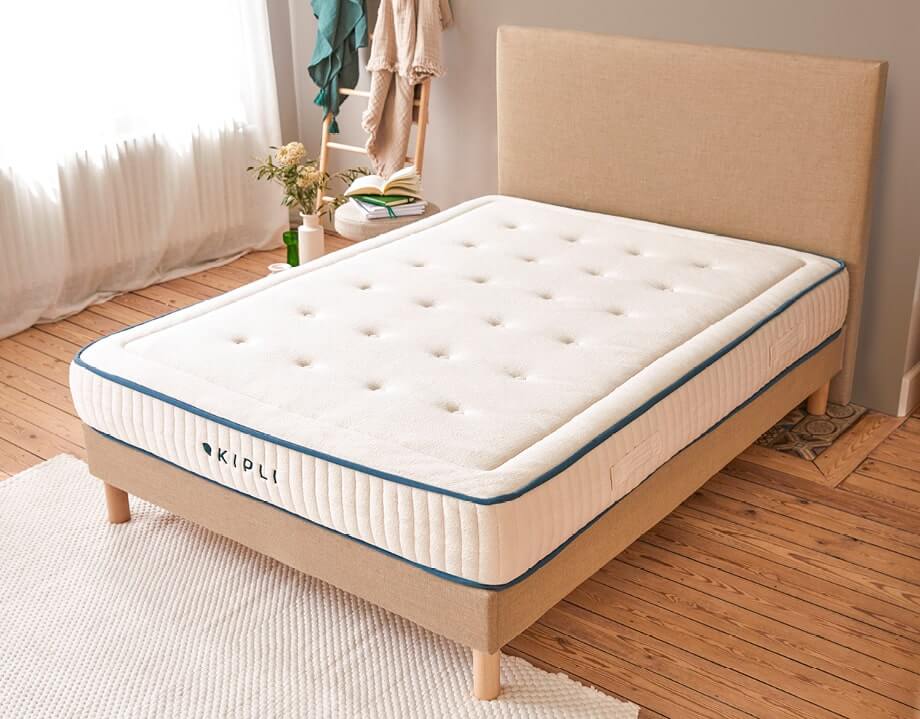
When choosing the mattress that best suits their needs—not just for sleep, but also for health—more and more people are opting for a latex mattress. We often hear about latex foam mattresses, but what exactly are they? And how do you choose the best product?
Polyurethane foam, viscoelastic polyurethane foam, and latex foam are the most commonly used foams in mattress production; in particular, polyurethane foams in Italy account for approximately 95% of the latex foam mattress market, including various combinations (sandwiches). We have many compelling reasons for deciding that our product line should exclusively feature natural latex foam.
Kipli has chosen to offer only mattresses made entirely of natural latex foam because we know that this material is superior to polyurethane and memory foam in many respects, even when combined.
Latex foam
Latex foam is a foam made from liquid latex and solidified through vulcanization. The remarkable property of latex molecules (particularly natural latex versus synthetic) is that they are extraordinarily long (you can imagine the molecules as a plate of cooked spaghetti); vulcanization creates three-dimensional bonds between the strands so that when they are stretched during the subsequent release phase, they essentially and quickly return to their previous shape (elastic property). The transformation requires the addition of sulfur and zinc oxide-based accelerators to the latex. The latex can be obtained by tapping the bark of the tree (Hevea brasiliensis) or through the polymerization reaction between styrene and butadiene to produce synthetic latex.
Kipli has chosen to manufacture its mattresses and pillows using exclusively and entirely natural latex for its products, eliminating synthetic materials.
Latex foam provides a precise response to every applied force and reacts instantly to every movement or change in pressure. This is the main difference between latex and memory foam mattresses, the latter of which are generally made from polyurethane foams.
Natural latex foam does not compress under pressure and, most importantly, does not sag as the temperature rises due to prolonged contact with the body. Latex foam maintains constant support proportional to pressure without becoming softer due to heat. Its unique ability to deform in proportion to pressure and in a perfectly precise manner for each individual anatomical region is a fundamental property for providing optimal comfort during sleep, particularly when sleeping on one’s side, where the pressure exerted by the shoulders and hips requires the mattress to deform significantly relative to its thickness.
Another difference between latex and memory foam mattresses is that latex foam is undoubtedly one of the foams that offers the best durability and retains its original elastic properties (laboratory tests in accordance with EN 1957 showed negligible losses in thickness and objective/subjective support both after 30,000 stress cycles simulating the mattress’s useful life and after 60,000 cycles; furthermore, the minimal variations are essentially attributable to the behavior of the cover/fabric).
Unlike other foams (including those derived from synthetic latex), passing the most stringent tests for emissions of harmful substances (VOCs) is easily achieved; in particular, the natural latex foam used by Kipli has obtained Oeko-Tex Standard 100 Class 1 certification.
Polyurethane foams
Polyurethane foam (polyol + isocyanate) is certainly the cheapest and lowest-quality foam used to manufacture mattresses or mattress toppers. Consumers are familiar with polyurethane foam, which is commonly used in the cushions of sofas and armchairs, often featuring attractive colors and a layered construction with different characteristics for mattresses. Polyurethane foam is derived from the reaction between a polyol (generally of hydrocarbon origin) and an isocyanate (a substance whose danger to workers is well-known and evident by typing “isocyanate safety data sheet” into Google). Polyurethane foams are also commonly used as layers applied on top of traditional or pocket spring mattresses, thereby easily increasing their thickness and visual appeal at the point of purchase. Polyurethanes can have highly variable densities (and thus be more or less lightweight); the quality and cost of the product are generally proportional to its density; precisely because of their low density, polyurethane foams lend themselves more easily to compression and rolling, a method of packaging that obviously simplifies the entire logistics chain.
Polyurethane foam can provide some degree of targeted support for the human body’s anatomy; however, when analyzing the behavior of the most common polyurethanes under applied stress, they exhibit a less linear response than natural latex, with a tendency to offer high resistance at low loads and then deform rapidly once a certain load threshold is exceeded.
Polyurethane foams rarely have certifications other than CertiPUR, which is a voluntary verification and monitoring program designed to ensure that no banned substances are used during production and that the product is safe for use; while this is an important step toward transparency and safety, it is clear that the program lacks independence, as both the organization and its criteria were developed within the industry itself.
Memory foam / Viscoelastic polyurethane
It is a type of polyurethane that contains special additives which alter its elastic behavior, causing the characteristic delay that allows one to see, for example, the shape of a hand resting on it for a few moments. Obviously, as with polyurethane, most of the components used in the preparation of “visco” are derived directly from petroleum chemistry (polyol + isocyanate).
Generally, “visco” foam is denser and therefore more expensive than polyurethane foam. This type of foam is certainly better able to conform to the body’s contours than standard polyurethane; however, it differs from 100% natural foam because it lacks performance in terms of support and load-bearing capacity (which is why it is usually used in a thin top layer of 2–3 cm), causing the phenomenon of progressive sinking, also due to the heat that ends up accumulating between the body and the compressed foam (even in the case of partially open-cell visco, the viscous nature of the material causes the cells to close due to compression when the foam is compressed, making them impermeable to air and heat in a vicious cycle). In this regard, we suggest asking an acquaintance who has purchased a visco mattress or pillow and can describe the unpleasant experience of sinking and progressive heat buildup, along with a lack of support. The loss of thickness in visco foam is progressive and increases with body heat; since, naturally, during nighttime sleep the body undergoes a series of major shifts (from a supine to a side position, for example), escaping the “deep pit” of viscoelastic foam requires significant muscular effort in the absence of the material’s elastic push, which inevitably leads to a decline in sleep quality or even waking up.
Even recent proposals to add heat-absorbing gels or microcapsules (phase-changing materials) to these foams are largely inadequate, since the amounts of heat that can be temporarily absorbed are orders of magnitude smaller than the actual amounts involved; not to mention that this simply adds more chemicals to the mix.
Kipli believes in natural latex mattresses and in the future
We stake our history and reputation entirely on natural latex. As described above, natural latex offers advantages in terms of durability and environmental sustainability (to produce a double mattress made of 100% natural latex, approximately 2,500 trees must be harvested in a single day, which corresponds to an area of about 40,000 m²). We know that no other material can offer all the qualities and performance benefits that natural latex provides while helping to improve the environment in which we live. We care for ourselves and the planet we share!