

Where does latex come from?
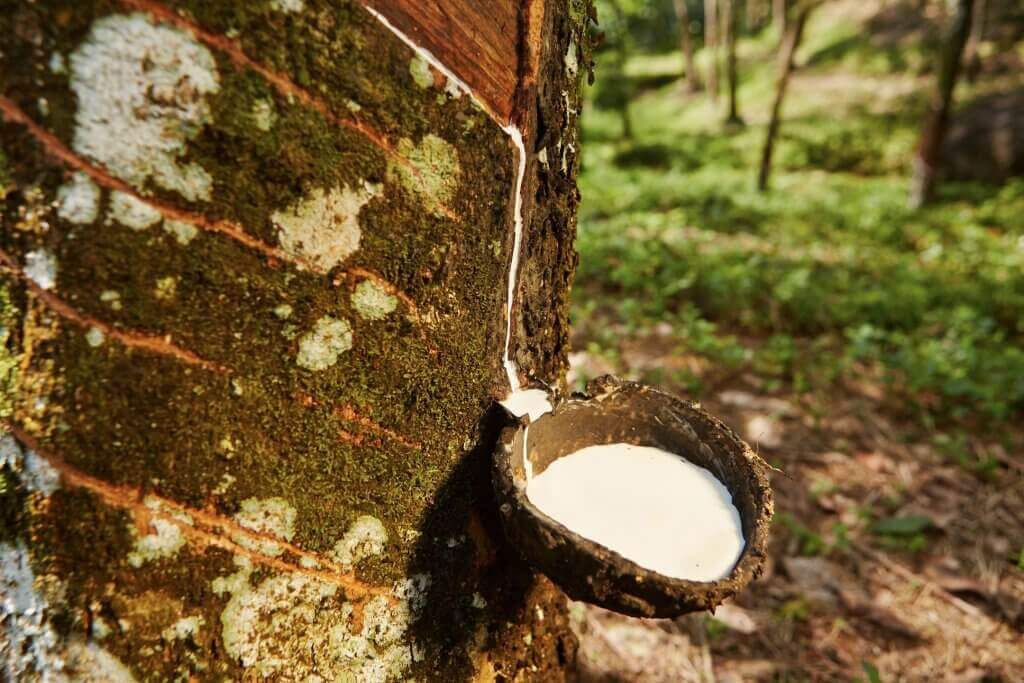
Latex is a natural product that we harvest from the rubber tree, Hevea brasiliensis, in liquid form. It is a sticky, elastic liquid that the Hevea produces primarily to protect itself from insects. Excess latex oozes out of the plant’s trunk like resin. It is not only the Hevea Brasiliensis rubber tree that produces this precious liquid, but an entire family of plants, which accounts for 14% of all tropical plant species. For these plants, liquid latex serves as an important source of protection against animals, particularly herbivores and insects. In fact, latex acts as a repellent against animals that feed on the plant. But some insects, in this struggle for survival, have developed an additional ability: they sever the plant’s “arteries” that carry the latex (much like humans do to harvest it). By performing this operation before feeding, they ensure a clean meal. However, most insects that attempt to feed on these plants instead become trapped, or fail to even reach their feeding goal, finding the latex inedible.
Other plants that produce latex
In nature, however, latex is also found in non-tropical species. It is estimated that, within the division of angiosperms (the most evolved plants, those that produce seeds), latex is present in 10% of all species. It is, in fact, a liquid composed of water combined with a variety of substances, such as proteins, enzymes, starches, sugars, resins, gum, oils, alkaloids, and tannins. This emulsion changes state and becomes gelatinous when exposed to air.
White, yellow, orange, or red—there are many shades of color that liquid latex can take on: much depends on the specific variety of the plant from which it comes, but the vast majority is white.
The micro-lattice and the lattice structure
Micro-latex has nothing to do with Hevea brasiliensis. It is a metallic material—the lightest metallic material in the world—one hundred times lighter than polystyrene. Despite its weight, it is incredibly strong, which is precisely why it has been compared to natural latex. It is a material used, for example, in the aerospace industry: to produce and build vehicles that, while still running on fuel, are lighter, resulting in significant cost savings in terms of structure.
There is also what is known in English as a lattice structure—an ordered network of points arranged to form a crystal—which has nothing to do with Hevea. Ultralight metal lattices have a low density due to their metal foam-like structure, which features numerous pores.
The extraction of liquid latex
Hevea brasiliensis is a tree that can grow up to thirty meters tall. It is recognizable by its characteristic three-lobed leaves. The Hevea brasiliensis tree is native to the Amazon rainforest. Initially, therefore, the economy linked to rubber tapping brought prosperity to those Brazilian cities located in strategic positions.
Widely known as the rubber tree, even in its smaller shrub form, the Hevea can still reach two meters in height. Some use it as a houseplant, but it requires space and significant exposure to light.
To extract the latex, it is first necessary to select trees at the right stage of maturity, then make an incision in the bark. This is done using a special technique that ensures no damage is done to the plant, which can be tapped hundreds of times over at least thirty years.
This, broadly speaking, is the life cycle of the rubber tree:
During the first five or six years of its life, the plant grows and no extraction takes place;
Starting in the 6th grade, the selection process begins;
Peak production is reached at around 12 years of age;
The trees continue to produce latex until they are about 30 years old:
This species is highly productive: approximately three kilograms can be harvested from each plant per year.
Once the liquid sap begins to flow from the plant, it is collected in a container placed at the base of the trunk. This is an ideal location—the milky liquid flows slowly and steadily down the trunk, pouring out in abundance from the holes that have been drilled into it.
The properties of the natural lattice and its uses
The properties of high-quality latex are evident from the very beginning. When it flows from the trunk of the Hevea tree, you can see the material’s typically sticky and elastic, yet soft, texture.
Latex is called “natural” because it possesses natural qualities that are extremely useful to humans. It is an antibacterial, anti-mold, and fungicidal substance. This makes it widely used in the manufacture of numerous healthcare products.
However, when deciding to use this material, one cannot overlook its elasticity. It can be deformed in various ways—by stretching and elongating it, or by applying pressure. In any case, latex will always return to its original shape. This is why it is also durable—because it retains its properties unchanged over time, even with heavy use.
In this case, we can truly speak of eco-sustainability. Not only is it a material of natural origin, but it is also a substance that does not require the addition of chemical components during processing. Components that would otherwise remain in the final product, proving toxic and capable of polluting the environment. Finally, as a testament to its eco-sustainability, latex can be recycled.
It is precisely these characteristics that make it useful for the production of everyday medical items, such as compression bandages, tourniquets, catheters, and gloves. The same applies to products for infants, from toys to diapers themselves.
Beyond medical accessories, latex is everywhere. It is found in clothing, as well as in chewing gum. There is also liquid latex that can be used for body painting. But the quintessential latex product, the one everyone knows, is the mattress and pillows.
Natural lattice and synthetic lattice
There is only one type of latex: natural latex, which is the only one and the most highly regarded because it guarantees superior quality.
Synthetic latex looks exactly the same but is fundamentally different and lacks the health benefits of the natural product.
These days, the market offers just about everything, including hybrid products that mix organic latex with other substances to modify it or “stretch” it. Manufacturers can adjust its composition to achieve a texture better suited to their intended purpose. The use of a non-natural product, even if only in part, is a clear sign of cost-cutting. All synthetic variants of latex mattresses, which are marketed as hypoallergenic, do not guarantee the health benefits and support of a 100% natural product.
What is latex foam?
When it comes to latex for mattresses, you may come across the term “latex foam”: but what exactly is it?
This term does not directly refer to whether the rubber is natural or synthetic, since there is latex foam made from organic latex and latex foam made from synthetic latex. Instead, this terminology refers to the manufacturing method. To make the latex “foamy,” air is added before curing. This process makes the material much softer, creating air bubbles within it. Having clarified this, it becomes clear that there is very little difference between latex foam and latex; the only difference lies in the presence of air at the raw material level. At the level of the final product, however, there is a difference: when compressed, they behave differently, and this is why they have a different impact on providing support for the body.
Lattice cycle management in mattresses and clothing
Among the various uses, let’s briefly touch on the clothing sector. You can buy sheets of latex or rolls of latex by the meter, but what are they used for? Since it is such a versatile material, it is used to make clothing on your own, without using a sewing machine. You simply need to use latex glue to assemble the garments, or solvent-based latex adhesives. The only precaution to take is to avoid exposing it to too much light, and when not being worn, it should be stored in complete darkness. To wash latex clothing, hand-wash it with a small amount of lukewarm water and a little specialized detergent, then allow it to air dry thoroughly.
As for the mattress, it all depends on the level of purity and the breathability of the cover. In any case, it is good practice to open the cover at least once a month to expose it to air and allow any moisture to evaporate. To clean a natural latex mattress, there is no need to wet it directly; simply wipe it down with a cloth lightly dampened with a pinch of baking soda. Afterward, let it dry for at least half a day.
Once the life cycle of the garment, mattress, or any other latex item has ended, it must be disposed of. If it is organic latex, such as that found in Kipli products, disposal is easy because natural latex is biodegradable and can therefore be composted.
If, on the other hand, it is synthetic latex, you will need to dispose of the mattress using the procedure for bulky waste.