

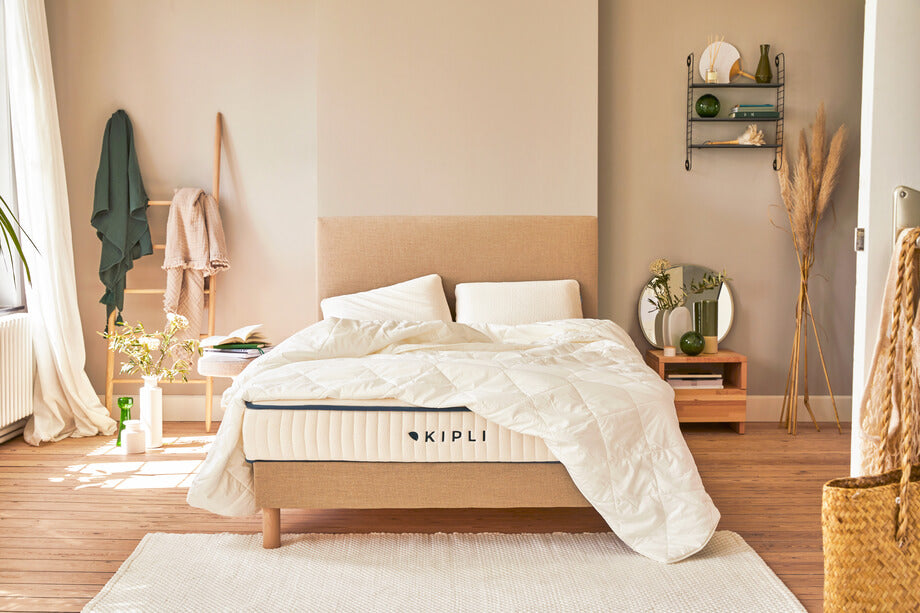
Did you know? These days, over 90% of the mattresses on the market are made from synthetic materials. Most of these are polyurethane foam mattresses (the most affordable ones), memory foam mattresses (made from thermosensitive polyurethane), pocket spring mattresses, and synthetic latex mattresses. Less than 10% of mattresses are therefore natural mattresses, mostly made of natural latex, cotton, and wool.
Before we even consider the intrinsic qualities of a mattress, we need to ask ourselves: is it right, in this day and age, to use raw materials derived from petroleum—the most polluting industry in the world? Sure, these mattresses have catchy names and very attractive prices, but they’re often just a smoke and mirrors. There’s little clarity regarding their composition, and the chemical treatments offer no real guarantees for our health.
The choice of natural materials in the face of the ubiquity of synthetic materials
Less than 10% of mattresses are natural—a rather low percentage. We are part of this large niche market for obvious environmental reasons. Two main raw materials are used to make an eco-friendly mattress: wool and 100% natural latex.
The History of the Kipli Mattress
Kipli is, first and foremost, a family business. It all began with Mario, the uncle of Davide, Kipli’s co-founder. In the late 1980s, Mario worked at Pirelli in the production of synthetic latex. In 1998, Mario decided to leave the company to start his own natural latex mattress factory in the Milan area.
Mario realized that natural latex is the material of the future: durable, long-lasting (lasting 12–15 years), breathable, and with the most positive carbon footprint. Davide then took up the baton, joining forces with Antoine to create the Kipli brand, with the goal of making a healthy and sustainable product accessible to everyone.
Comfortable design, made in Italy
We designed the Kipli mattress to be reversible to suit everyone’s preferences, with two levels of firmness:
-
Soft side (5/10)
-
Firm side (7/10)
We didn’t compromise: we chose a 20-cm-thick layer of natural latex. There are only three natural latex factories in Europe, and we chose the Italian one, which offers the highest quality thanks to special heating systems and rigorous quality controls.
Why this lining and not another?
Nearly 80% of mattress covers on the market are made of polyester. Kipli covers, on the other hand, are made of unbleached organic cotton. We’ve chosen a traditional cover: sturdy, durable, and hand-sewn. It ensures durability and complements the mattress’s core.
New: We are launching our new cover made of organic cotton and Tencel, filled with Patagonian wool. It will be 100% natural, durable, and naturally flame-resistant without any chemical additives.
Services, warranties, and the right price
No compromises on the shopping experience: free shipping, delivery to your doorstep, a 10-year warranty, and a 100-night trial.
How much does a Kipli mattress cost?
The co-founders decided to go against the grain: we sell exclusively online to cut distribution costs. The net margin on a mattress is 7%. That’s how we’ve managed to offer a 100% natural latex mattress at prices that are about half those of big-box retailers for the same quality.
In conclusion...
Since sleep should be the most natural thing in the world, the entire Kipli team works hard to make your bedroom a healthier place through transparent communication.